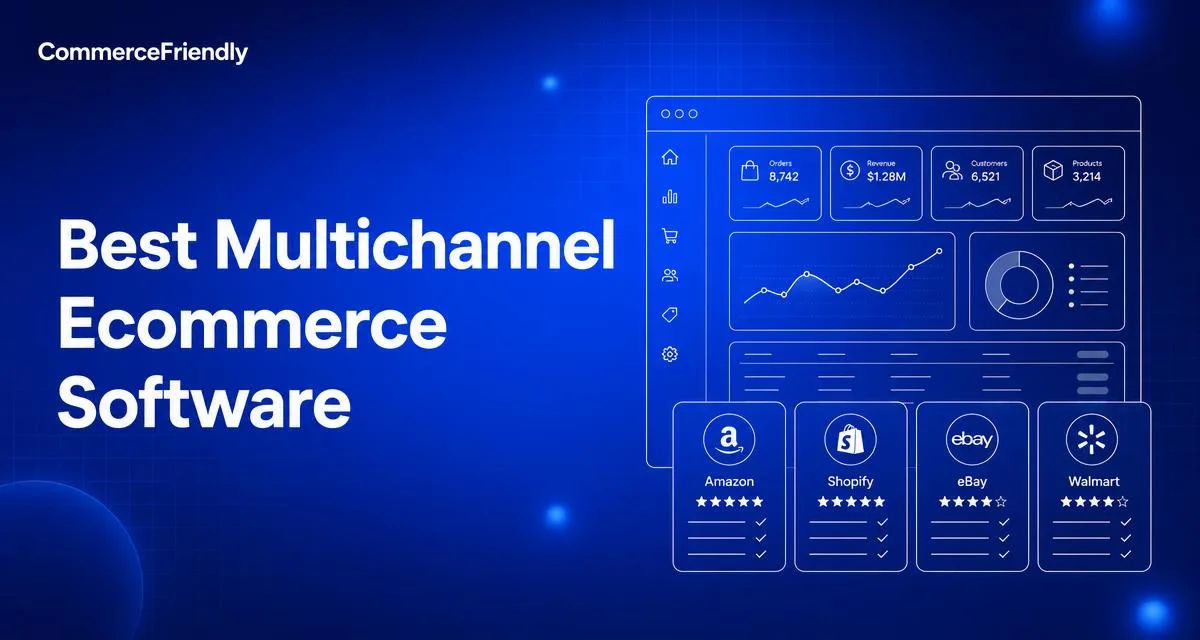
Best multichannel ecommerce software
Multichannel tools fall into three groups: listing managers, inventory and order systems, and full operations platforms. Choosing the wrong group is the usual reason a tool gets replaced within a year.
Know which category you actually need
- Listing manager: bulk-creates and edits marketplace listings. Good for catalog-heavy sellers.
- Inventory and order management: keeps stock accurate and centralises fulfilment. The core need for most sellers.
- Full operations platform: adds purchasing, warehousing, accounting and analytics for scaling teams.
- Marketplace-native apps: cheapest start, but each connection is separate and gaps appear at volume.
Who is best in this industry
| Tool | Category | Best for | Main limit |
|---|---|---|---|
| Linnworks | Operations platform | UK and EU sellers with warehouse operations | Setup complexity and cost |
| ChannelAdvisor | Enterprise multichannel | Large brands and retailers | Enterprise pricing and onboarding time |
| Sellbrite | Listings and inventory | Small sellers on Shopify plus marketplaces | Fewer advanced workflow rules |
| Zentail | Catalog and listings | SKU-heavy sellers needing clean data | Focused on US marketplaces |
| Cin7 / Dear | Inventory and ERP-lite | Multi-warehouse and wholesale mixes | Learning curve for small teams |
| Shopify Marketplace Connect | Native connector | Shopify-first sellers testing channels | Limited logic beyond basic sync |
Evaluation checklist before you sign
- How fast does inventory propagate, and can you set per-channel buffers?
- Does it support your fulfilment mix: FBA, MCF, 3PL, dropship and retail pickup?
- Can pricing rules differ per channel and respect marketplace policies?
- How are returns, refunds and cancellations handled end to end?
- Does it export clean data to your accounting system without manual journals?
- What is the true cost at your order volume in twelve months, not today?
How much should you budget for multichannel software?
Cost usually scales with order volume and SKU count rather than being a flat fee, so the tool that looks cheapest at your current size is not always cheapest once you grow. Budget for the tier you expect to reach within twelve months, not just where you are today.
| Business size | Typical monthly software cost | Common choice |
|---|---|---|
| Under 50 orders/day | $0 to $100 | Native connectors or a light listing tool |
| 50 to 500 orders/day | $100 to $600 | Dedicated inventory and order management software |
| 500+ orders/day or multi-warehouse | $600 to $3,000+ | Operations platform or enterprise multichannel software |
Common mistakes when choosing multichannel software
- Choosing on price alone and discovering the tool cannot handle your fulfilment mix once volume grows.
- Skipping a trial with real order data, which hides sync delays that only show up under load.
- Assuming a listing manager will also manage inventory accuracy, when the two solve different problems.
- Not checking how the tool handles marketplace policy differences, leading to automated pricing that breaches a marketplace's rules.
- Signing an annual contract before confirming the accounting export matches how your bookkeeper actually works.
Why CommerceFriendly
Tools only work when the underlying configuration is right. CommerceFriendly designs the stack around your channels, fulfilment model and margins, then configures the software so it runs correctly from day one.
We fit the software to your operation rather than forcing your operation into a tool.
Buffers, mappings, pricing rules and order routing are set up and tested.
Fees and subscription tiers projected against your real order volume.
Add channels later without re-platforming your operations.
Frequently asked questions
How much does multichannel ecommerce software cost?
Pricing typically starts around $50 to $100 a month for small catalogs on listing or inventory tools, rising to several hundred or a few thousand dollars a month for enterprise platforms like ChannelAdvisor at higher order volumes. Most tools price on a mix of order volume, SKU count and connected channels, so cost scales with growth rather than being fixed.
What is the difference between a listing manager and an order management system?
A listing manager focuses on creating, editing and bulk-publishing product listings across marketplaces, while an order management system focuses on inventory accuracy, order routing and fulfilment. Many sellers need both, though order management usually has the bigger effect on preventing oversells and late dispatch.
Can I switch multichannel software later without losing data?
Generally yes, since most tools export catalog, order history and inventory data in standard formats, but the migration itself takes time to remap fields and retest sync rules. Choosing a tool that fits your fulfilment model from the start avoids an unnecessary migration within the first year.
Do I need multichannel software if I only sell on two channels?
At low order volumes, native connectors such as Shopify's own Amazon or eBay integrations can be enough. Once daily order counts rise or you add a third channel, dedicated inventory and order software usually pays for itself by preventing oversells and reducing manual reconciliation.
What features matter most when comparing multichannel ecommerce software?
Inventory sync speed and per-channel buffers matter most, since slow or unreliable sync is the leading cause of oversells. After that, fulfilment flexibility, channel-specific pricing rules and clean accounting exports are the features that most affect day-to-day operations.
Is enterprise software like ChannelAdvisor worth it for a small business?
Usually not. Enterprise platforms are built for large catalogs and teams and come with onboarding time and pricing to match, so a small business is typically better served by a lighter listings or inventory tool until order volume and team size justify the larger platform.
Keep reading
Automate orders, inventory, tax and marketing workflows end to end.
The full launch sequence, from product data to first paid order.
How the major platforms compare on cost, speed and scale.
When to move off Shopify and which stacks are worth evaluating.